Observed construction
48 / 52
Construction starts · 2017–2024
Of 52 nuclear reactor construction starts worldwide, 48 used Chinese or Russian designs.
IEA · published Jan 2025
Civilian nuclear power · Industrial deployment
Siderian
The West knows how to run nuclear plants. It must rebuild the ability to build them repeatedly.
There is a nuclear race, and the West is losing ground in new construction. The challenge is to turn proven reactor technology into a continuing industrial program. Siderian is being developed to connect the projects, suppliers, evidence, and decisions that make that repetition possible.
The evidence behind the argument
New construction has concentrated around a few national programs. Electricity demand is growing again. The question is whether Western projects can become dependable industrial orders.
Observed construction
48 / 52
Of 52 nuclear reactor construction starts worldwide, 48 used Chinese or Russian designs.
IEA · published Jan 2025
Published demand outlook
415 → 945
Total global data-centre electricity consumption: the 2024 estimate and the 2030 IEA Base Case. This is not an AI-only forecast.
IEA · published Apr 2025
Siderian ambition
$50–60
The target range for repeat Western nuclear deployment. An objective, not a forecast or guarantee.
Siderian target · published cost models discussed below
Dataset cut: 15 August 2026. Records, forecasts, and ambitions are distinguished throughout.
Inspect the evidence →The history
A nuclear plant can keep producing electricity for decades after the industry that built it has stopped taking orders. That is the distinction behind the Western predicament. The reactors kept running. The continuity of new construction did not.
01 · The original buildout
The early nuclear buildout left the United States and Europe with far more than generating stations. It created experienced utilities, engineering organizations, specialist manufacturers and construction teams. France made the connection explicit: after the oil shock, nuclear construction became a national program. The value lay in carrying people and industrial capability from one project to the next.
Source and context →02 · The break in continuity
The Western retreat was not one event. Some countries chose phaseout; others retained their fleets but placed too few new orders to sustain construction capability. A utility could remain an excellent operator while the suppliers and trades needed for its next plant dispersed. The distinction matters: an operating fleet records past achievement, not necessarily present capacity to build.
Source and context →03 · The difficult restart
Vogtle brought AP1000 into commercial operation in the United States. It also exposed the cost of restarting a supply chain and workforce while construction was already under way. DOE identifies incomplete design, an immature supply chain and an untrained workforce at the start. The lesson is practical: settle the work, prepare the suppliers and organize execution before expensive commitments make corrections harder.
Source and context →04 · The second race
China and Russia dominate the construction-start record used here. South Korea offers another important lesson: its reactor program supplied the reference for the UAE’s four-unit Barakah plant. These are different political and financial systems. They nevertheless force the same question on Western buyers: how much of the last project will the next one actually inherit?
Source and context →Figure 1 · Selected operating-fleet histories
Method and sources →Selected years · operable reactors
| Country | 1970 | 2000 | 2026 |
|---|---|---|---|
| United States | 20 | 104 | 94 |
| China | 0 | 3 | 64 |
| Germany | 3 | 19 | 0 |
Selected U.S., German and Chinese trajectories reconstructed at intervals from public reactor records. The 2026 Chinese endpoint is WNA’s operable count of 64, not the narrower PRIS operational count. These selections are not the whole Western fleet. Operating stock is neither annual construction cadence nor generating capacity; country case studies supply the institutional context.
Data / source cut: 2026-08-15
These are selected national trajectories, not a complete comparison of the West with China. Operating-reactor counts show the legacy of past construction. The case studies below explain what a stock chart cannot: how programs were organized and what happened when construction resumed.
France’s response to the oil shock joined a public electricity strategy to a sustained nuclear construction program. It is evidence that deployment can be organized at national scale, not that every subsequent French project would be easy. The later difficulties of large new builds underline the distinction between possessing an operating fleet and maintaining the capability to deliver its replacement.
Continuity has to be maintained; it cannot be assumed from the size of the existing fleet.
The completion of Vogtle 3 and 4 is an industrial asset: an operating reference, trained people and experience of construction and commissioning. Those gains will be wasted if the next project changes the design unnecessarily or has to reconstruct the supplier base. Equally, repeating a design is not enough on its own. Work planning, quality, construction supervision and owner competence still determine whether the lessons reach the field.
The next order must carry forward the usable design, records and people—not simply the reactor name.
Barakah comprises four APR1400 units and uses South Korean reference plants. That makes it a useful counterexample to the claim that programmatic delivery belongs only to China or Russia. A reference plant does not eliminate the receiving country’s licensing, owner and operating obligations. It gives those institutions a concrete basis on which to work.
A Western rebuilding strategy should learn from allied industrial experience, not define it out of the argument.
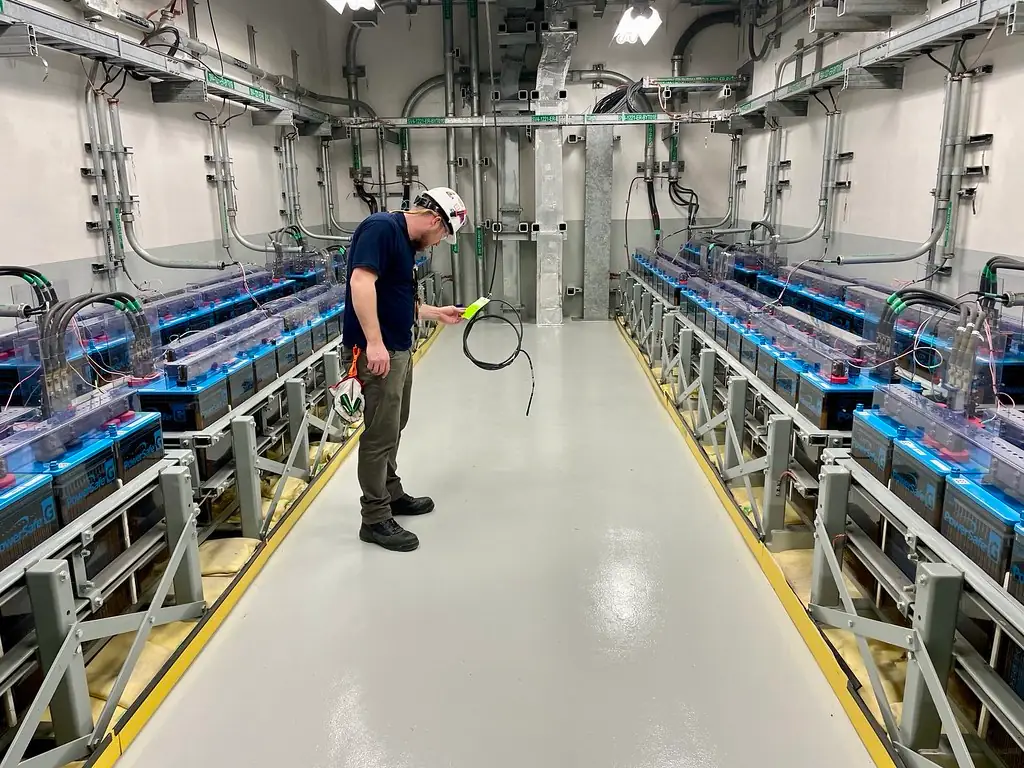
Vogtle Unit 4 · Georgia
The useful inheritance is practical: people who have done the work, equipment that has been qualified, and records the next project can use.
Photo: U.S. Nuclear Regulatory Commission · CC BY 2.0. Cropped to fit. The photograph does not imply NRC affiliation or endorsement.
Figure 2 · Construction starts, 2017–2024
Method and sources →IEA’s 52 starts: 25 Chinese, 23 Russian, two UK / European and two South Korean / national designs. Each cell represents a reactor start, not equal electrical capacity. The comparison describes design origin, not construction location or a political alliance.
Data / source cut: 2024-12-31
The cost of discontinuity
China builds a fleet, the West makes collectors' items.
A deliberately sharp comparison. Western countries still operate extensive fleets. The weakness lies in new construction: too often, each project must reconstruct the supplier relationships, workforce, and delivery organization that its predecessor needed.
Demian Reidel · Founder's letter
The present challenge
Electricity demand, renewed government interest and long-lead financing have changed the conversation around nuclear. They have not shortened the time needed to qualify a factory, train a construction team or establish a project’s licensing and financial basis.
The risk is no longer only too few orders. It is a queue of prospective buyers competing for the same industrial attention before anyone has established which commitments can be executed. Announcing demand and organizing a build program are different jobs.
Demand
Total data-centre electricity consumption: 2024 estimate to the IEA’s 2030 Base Case. AI is a major driver, not the whole category.
IEA, Energy and AI →Finance
The World Bank's first nuclear re-engagement in decades opens the door for other development banks and private investors.
World Bank Group / IAEA, June 2025 →Supply
DOE conditional long-lead financing for 10 large-scale reactors, with utility partners still to be selected.
U.S. DOE, June 2026 →These developments have different dates and conditions. The demand figure is a 2025 forecast; policy support is not a project commitment. The construction register below retains its published 15 August 2026 cut.
Figure 3 · Published construction register, 2025–2026
Method and sources →Strict reactor-building register
Every counted start. No announcements.
Cut · 15 August 2026
Lufeng 1
China · 24 Feb 25
Leningrad 2-4
Russia · 20 Mar 25
Shidaowan 2
China · 08 May 25
Shin-Hanul 3
South Korea · 20 May 25
Taipingling 3
China · 10 Jun 25
Jinqimen 1
China · 10 Aug 25
Zhaoyuan 1
China · 18 Nov 25
San'ao 3
China · 19 Nov 25
Ningde 6
China · 16 Dec 25
Lufeng 2
China · 22 Dec 25
Bailong 1
China · 25 Dec 25
Xuwei 1
China · 16 Jan 26
Kursk 2-3
Russia · 31 Jan 26
Paks II-1
Hungary · 05 Feb 26
Kaiga 5
India · 01 Mar 26
Kaiga 6
India · 01 Mar 26
Jinqimen 2
China · 04 Apr 26
Taipingling 4
China · 10 May 26
Shin-Hanul 4
South Korea · 29 May 26
Darlington SMR-1
Canada · 26 Jun 26
15
China + Russia
1
West · Canada
4
Korea + India
Excluded: Uzbekistan's June RITM-200N ceremony. WNA does not classify the pour as safety-related reactor-building first concrete and does not list the unit under construction as of this cut.
Siderian audit of first-concrete dates in the public reactor register. The 20 starts comprise 12 Chinese designs, 3 Russian, 2 South Korean, 2 Indian, and Canada's BWRX-300. The West is therefore 1 against China and Russia's 15; South Korea and India are shown separately. Uzbekistan's ceremonial June pour is disclosed but excluded because WNA does not classify it as safety-related reactor-building first concrete or list the unit under construction.
Data / source cut: 2026-08-15
What recovery requires
The supplier must decide whether to invest before every buyer is ready to order. The buyer wants confidence in delivery before committing capital. The lender wants evidence that both can perform. Waiting for each party to move first leaves the program stranded.
Governments can change that bargain through policy, revenue arrangements and financing support. Vendors can mature the design. Owners and contractors must prepare the work. Across those responsibilities, six connections need to hold.
01
Interest is not an orderbook. A manufacturer deciding whether to expand needs credible buyers, defined equipment and a sequence of commitments it can use.
02
Necessary site and regulatory changes must be made. Optional redesign should carry a visible price in engineering, qualification, schedule and lost reuse.
03
A supplier’s name on a schedule does not establish an available production window. Capability, workload, quality records and commercial commitments need to agree.
04
Early studies, a cancellable reservation and fabrication are different decisions. Each needs the authority, funding and protection appropriate to the loss being accepted.
05
Owners, vendors, lenders and suppliers should be able to rely on an agreed record, with permission to use it and a clear account of its limits.
06
A program needs an agreed response when one buyer loses readiness: what must be fixed, what can move, and which commitments remain binding.
This is Siderian’s synthesis of the coordination problem. It does not replace engineering, licensing, construction management, fuel provision, waste arrangements or public consent. DOE’s industrialization framework and IEA’s financing analysis describe the wider requirements.
Why Siderian
Nuclear projects divide responsibility among the plant owner, reactor vendor, equipment suppliers and lenders. Each has obligations it cannot delegate away. Yet meeting those individual obligations does not necessarily organize the next several projects into a dependable construction program.
Siderian is being built for that gap. Its proposed role is to establish which commitments the evidence supports, make constraints visible across participating projects, and preserve the record as designs, schedules and counterparties change.
The ambition is a repeat AP1000 program whose next project can use what the previous one learned. Siderian would begin with a bounded assessment of a buyer’s proposed commitment and the equipment behind it. A wider coordinating mandate has to be earned through useful work and granted by the parties concerned.
How Siderian would do it
01
Specify the decision in front of the buyer. Is it funding a study, reserving equipment or authorizing manufacture? Identify who can approve it and who carries the downside.
02
Review the records needed for that decision. Separate a genuine adverse finding from a missing document, and technical capability from an enforceable reservation.
03
Work from the agreed reactor and equipment baseline. Make departures visible and put their consequences before the parties responsible for accepting them.
04
Say what can proceed, what cannot, and why. Name outstanding conditions, the people responsible for resolving them, and the date beyond which the determination cannot be relied on.
05
Monitor the conditions that mattered. If the facts change, revisit the conclusion and administer any agreed cure or resequencing process within the mandate granted.
Vogtle provides an operating U.S. reference and recent experience of construction, supply and commissioning. Westinghouse has announced a standardization effort based on Vogtle Unit 4. That makes AP1000 a concrete starting point for Siderian’s proposal, not a claim that one reactor suits every market. Design changes and licensing remain the responsibility of the vendor, owner and regulator; a submitted revision is not an approved one.
Vendor announcement and regulatory context →Siderian is a founding-stage initiative. Its independent assurance governance is in formation; no independent assurance authority has been appointed. The proposed model has not yet demonstrated fleet-level adoption or cost savings.
A decision in practice
A buyer wants a 60-day option on equipment for a proposed nuclear project. The supplier has supported its production window. The contract limits the buyer’s possible loss to $1.5 million. Should the buyer commit?
Fictional worked example, not a customer case or an assurance opinion. All amounts and conditions are illustrative. It demonstrates one decision, not qualification of an entire plant.
A larger or less reversible commitment needs a new review. An earlier approval does not silently expand with the project.
What the supplier can deliver
Technical capacity is a finding about capability and availability. It does not itself grant the buyer a reservation.
What the buyer has secured
An option or reservation depends on the signed terms, required consents and activation conditions. A database entry creates no commercial right.
The economic objective
$50–60
USD / MWh · objective, not forecast
A nuclear plant commits most of its capital before it earns revenue. A delay therefore costs more than another year on site: it extends financing exposure and postpones electricity sales. Rework can damage cost, schedule and confidence at the same time.
Repetition offers a way out, provided the next project actually reuses the design, supply capability and lessons of the last. Siderian’s proposed contribution is to make those conditions visible and governable. It cannot supply cheap capital, competent construction or a power contract by issuing a report.
Levelized cost of electricity (LCOE) spreads a plant’s modeled lifetime costs over its modeled electricity output. It is not the electricity tariff or a complete measure of value to the grid. The studies below answer different questions, in different dollar years; they are deliberately not plotted on a common cost axis.
Figure 4 · Cost models: financing, repetition and policy
Method and sources →IEA / OECD NEA · 2018 USD
Chinese new-nuclear model; 85% capacity factor and a 2025 commissioning assumption. The three cases change the discount rate.
These are published model cases, not observed current fleet costs.
Idaho National Laboratory · 2024 USD
Moderate U.S. scenario, expressed in successive two-unit builds. The tenth series is not the tenth reactor.
With 40% investment tax credit
$72/MWh
Without the credit
$106/MWh
With 40% investment tax credit
$49/MWh
Without the credit
$65/MWh
Preliminary academic projections; not investor-grade estimates or evidence of achieved savings.
Separate panels preserve each study’s dollar year and assumptions. The IEA/NEA cases vary financing in 2018 USD; INL’s U.S. scenarios vary repetition and tax support in 2024 USD. No cross-study normalization, measured fleet-cost claim or Siderian-attributed saving is implied.
Data / source cut: 2026-08-15
The $50–60/MWh range expresses Siderian’s ambition for repeat Western deployment. An investable estimate still needs a named project, dollar year, financing structure, construction schedule and operating assumptions. No fixed reduction in cost or financing spread is attributed to Siderian’s assessments.
The institutional test
A qualification is worth little if the customer can buy the answer. Siderian’s proposed governance separates commercial origination from the people making assurance decisions. The founder would have no override of an adverse determination; material disagreements would have an independent appeal route.
Siderian is designed for independent operation. That independence is not yet an accomplished fact: its assurance governance is being formed and no independent assurance authority has been appointed.
The next proof is institutional as well as technical: appoint competent reviewers, adopt the conflict rules, test the method on difficult cases and establish whether counterparties will use the resulting judgments.
From the founder
“No durable nuclear fleet built itself. France made a national program. South Korea built a standardized export system. China is sustaining the world’s largest active construction program.”
Demian Reidel
Founder, Siderian · From the August 2026 letter
Read the full founder’s letter →Founder · documented record
Demian Reidel is a physicist and economist whose career spans capital markets, central banking, public strategy, and nuclear governance. He founded Siderian to build the rules and evidence layer required for repeat nuclear deployment.
His role is to establish the institution and its commercial purpose. The people making technical and assurance judgments must have the expertise and independence to reach their own conclusions.
Private diligence
A private diligence path for qualified counterparties. Confidential material is shared under NDA, on request.
No transaction terms are published on this site.